• Shows & Ticketing
    • Purchase Tickets
    • Auditions
    • Family Guide
    • Privacy and Refund Policies
  • About Us
    • Our Mission
    • Faculty and Staff
    • Sights and Sounds
  • Education
    • Master Calendar
    • Resources
    • Curricular Classes
  • Troupe 1794
    • Student Leadership
    • International Awards
    • State Awards and Honors
    • Thespians Forever
  • Support Us
    • Gift Cards
    • Star Boosters
  • Contact Us
Floyd Central Theatre Arts
  • Shows & Ticketing
    • Purchase Tickets
    • Auditions
    • Family Guide
    • Privacy and Refund Policies
  • About Us
    • Our Mission
    • Faculty and Staff
    • Sights and Sounds
  • Education
    • Master Calendar
    • Resources
    • Curricular Classes
  • Troupe 1794
    • Student Leadership
    • International Awards
    • State Awards and Honors
    • Thespians Forever
  • Support Us
    • Gift Cards
    • Star Boosters
  • Contact Us

Plan Your Visit

2026-2027 Season Family Guide

We want Floyd Central Theatre Arts to be a welcoming place for every audience member that comes to see our shows! We also understand that various elements can impact individual patrons in different ways. Rather than providing a "rating" for each show, we hope that the following information can help you make informed choices for your family based on your personal needs and preferences. 
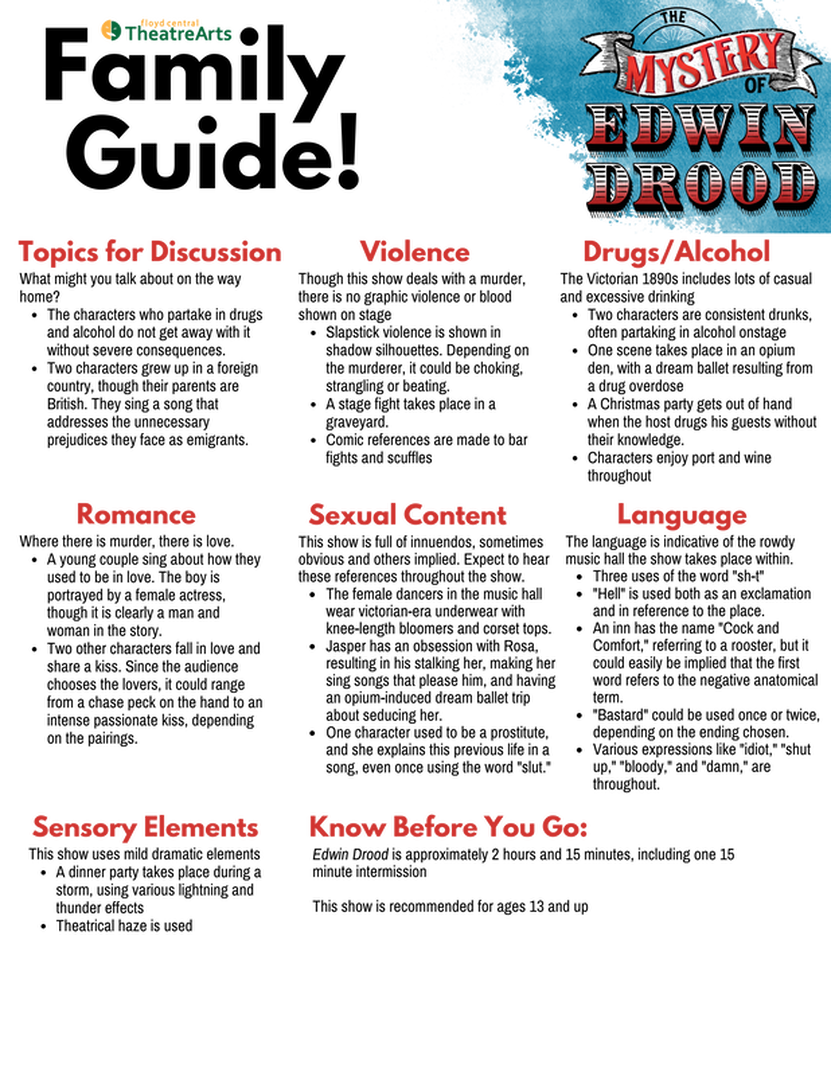
WAITRESS: HIGH SCHOOL VERSION

This title is rated PG-13 and recommended for ages 13+.
​Content includes abusive relationships, extramarital affairs, and multiple references to and discussions about pregnancy. 
Details are listed below. Please note: many spoilers are included
If you know the story of Waitress, you might be asking yourself, “Why would a high school do this show? Why take the time to adapt it into a high school version?”

Beyond the honor of being the first high school in the nation to produce this title, we believe Waitress: High School Version provides a meaningful opportunity to explore the nuances of relationships in a time when language like “toxic” is often overused or misunderstood. As students navigate a world shaped by technology and sensationalized media, it can be difficult to distinguish between labels and lived reality. This story invites deeper reflection. Jenna’s experiences illustrate that harmful dynamics can take many forms, whether it is an overtly abusive partner or a relationship that quietly disregards personal boundaries. Though some relationships in the show may appear consensual on the surface, they raise important questions about respect, agency, and vulnerability.

These issues already exist in students’ lives. Young people are not encountering topics like unhealthy relationships or unplanned pregnancy for the first time through this musical. In fact, they already see and hear about them through peers, social media, television, and real life. Avoiding these topics does not eliminate them; it simply removes an opportunity for thoughtful, age-appropriate dialogue.  Presenting these themes in a structured, supervised, and educational environment allows students to process them with guidance rather than through misinformation or isolation. This story does not glorify abuse or infidelity, it examines them. It encourages questions such as: What does respect look like? What are the warning signs of control or emotional harm? Why might someone remain in an unhealthy situation? Rather than presenting a simple moral framework, the story reflects real life with imperfect people making complicated choices. The protagonist makes imperfect choices and ultimately moves toward a healthier, more self-determined future. Our hope is that students gain the tools to recognize the difference between uplifting and draining relationships, and to practice setting boundaries in their own lives.

At the same time, it highlights the power of community. Jenna’s journey is shaped not only by her struggles, but by the strength she finds in friendship and support. These relationships model the importance of connection, advocacy, and surrounding oneself with people who uplift and empower.

Moreover, the educational value of this production for theatre students is exceptionally high. With music and lyrics by Sara Bareilles, the show offers contemporary vocal challenges and storytelling opportunities in areas and techniques where many of our students have not yet had formal training. The show emphasizes character development, subtext, and grounded, dramatic acting, which are skills that are essential for a rigorous theatre education. High schools often struggle to find productions that center complex, flawed, and fully human female characters while also providing meaningful material for an entire cast and crew, and Waitress meets that need in a powerful way.

As a pilot school for Waitress: High School Version, we also have the unique opportunity to help shape the future of this title through collaboration, revisions, and feedback with the publishers. The choices we make will influence how this show is experienced by students and audiences across the country for years to come. That is both an incredible honor and a responsibility we take seriously.

While this production may not be for everyone, it is the right fit for our department and our students at this moment in time. We are proud to share this story with our community and hope you will join us for Waitress: High School Version in November 2026. 

ROMANCE

Two relationships in the story are extramarital affairs, without the knowledge or consent of their married partners. All parties in the relationships acknowledge at multiples times that what they are doing is wrong. 

Three different couples kiss, hug, and show affection in various ways. One character mentions "having a hard time walking" after a date with her beau. 

All couples shown on stage are adults in heterosexual relationships.

LANGUAGE

Mild words include tush, crap, dang it, piss, stupid, friggin, freaking, jerk, keister, loser, shut up, and hussy.

"Ass" is used once. A character exclaims, "Lord have mercy."

A pie is called "biblically good." A man leaves a group of women joking that he will, "die of estrogen asphyxiation."

Friends briefly speculate if another unseen character is gay. 

VIOLENCE

Earl is verbally and physically abusive towards his wife Jenna. He shouts, throws object, pushes, smashes objects, and emotionally manipulates her. Though not gratuitous, these actions could be disturbing for some viewers. 

Jenna remembers her childhood through pantomimed visions of violence from her father towards her mother. 

SENSORY ELEMENTS

Loud or Suprising Noises: A guitar is smashed by an angry male character. A female character goes into labor and often shouts out in pain during the contractions. 

Lighting Effects: Dramatic lighting changes and sudden blackouts are used to indicate flashbacks or to fast forward in time.
​

Fog & Haze: Stage fog and haze may be used for atmosphere. All products are water-based.

DRUGS & ALCOHOL

No drug or alcohol use is depicted.

It is implied that Earl is an alcoholic.

Jenna says she got pregnant when she was drunk.

A pregnant patient is told not to drink alcohol during her pregnancy.

POSITIVE MESSAGES

Themes include the importance of positive community, 

Ogie is incredibly attentive and loving towards Dawn and treats her friends with the same kindness.  

​
When Jenna finally leaves her husband, she doesn't belittle him or respond in the way that he treated her. She does so firmly, setting a boundary with respect and dignity. 

OTHER ELEMENTS

A character reads their horoscope. 

A NOTE ON PREGNANCY 

​This musical follows a pregnant woman and birth of her child, so much of the PG-13 content results from how characters discuss this event. The main character is not thrilled to be pregnant at first, so the miracle of pregnancy is not always discussed in a positive manner. 

A character takes a pregnancy test offstage. Her friend tells her to "pee on a stick," and, "Do not insert the test stick into your..."

​Discussing how babies are made, phrases like, "his machinery is broken," "his boys don't swim," "get away unprotected," "I slept with my husband," and "betrayed by my eggs," are said by various characters, all to serve comedic purpose. No further details are given or anatomical terms used.

A character referring to her sagging breasts twice as "droopy boobs." Pregnancy is referred to as being "knocked up" and "a bun in the oven," while the baby growing inside is called a "parasite." 

Abortion, miscarriage, and adoption are each mentioned once, very briefly. 

When visiting the OBGYN, various symptoms of pregnancy are discussed as typical for a medical relationship, like spotting and bleeding.

We watch the early stages of labor in childbirth, including contractions, vocal outbursts, and breathing techniques. 
​
Floyd Central Theatre Arts
6575 Old Vincennes Road
Floyds Knobs, IN 47119

Buy Tickets
Box Office: (812) 542-2284
Theatre Administrative Assistant: (812) 542-8504 x30046
Ticketing Website: floydcentral.booktix.com
Picture
  • Shows & Ticketing
    • Purchase Tickets
    • Auditions
    • Family Guide
    • Privacy and Refund Policies
  • About Us
    • Our Mission
    • Faculty and Staff
    • Sights and Sounds
  • Education
    • Master Calendar
    • Resources
    • Curricular Classes
  • Troupe 1794
    • Student Leadership
    • International Awards
    • State Awards and Honors
    • Thespians Forever
  • Support Us
    • Gift Cards
    • Star Boosters
  • Contact Us